
Hi, I'm David M. I live in Detroit. Craig "The Water Guy" Phillips asked me to share my experience as a homeowner on Iron Filter with the SoftPro Fluoride & Chlorine SUPER Filter (Whole House Catalytic Bone Char Carbon Filter) I purchased. This is how my adventures played out. I hope this helps you in your decision.
Did you know that the quality of your home's water can impact everything from your morning coffee taste to your family's long-term health?
When I first started researching whole house water filtration systems, I had no idea how deep this rabbit hole would go. What began as a simple quest to remove the chlorine taste from our tap water evolved into a comprehensive education about fluoride removal, catalytic carbon, and bone char filtration technology.
Like many homeowners in Detroit, I'd grown tired of the chemical taste in our municipal water supply. My wife constantly complained about the smell when filling up the bathtub, and I noticed our coffee never tasted quite right. After months of buying bottled water and dealing with the inconvenience, I decided it was time for a permanent solution.
That's when I discovered the SoftPro Fluoride & Chlorine SUPER Filter with its unique combination of catalytic carbon and bone char media. But as you'll see in my detailed experience below, the installation process raised some important questions that other homeowners should know about.
The Water Quality Crisis That Started My Search
Living in Detroit, water quality isn't just a preference—it's a genuine concern that affects daily life. Our municipal water, while treated to meet federal standards, still carries that unmistakable chlorine odor and taste that makes you question what you're actually consuming.
The problem became particularly noticeable during our morning routines. My wife, who's sensitive to chemical smells, would actually hold her breath while running water for her shower. Our teenage daughter refused to drink tap water, insisting it tasted "like a swimming pool." Even our houseplants seemed to struggle, with brown tips appearing on leaves despite consistent watering.
What really opened my eyes was learning about the science behind our water treatment process.
Municipal water treatment facilities use chlorine and chloramines as disinfectants to eliminate harmful bacteria and viruses. While this process makes water safe from biological contaminants, it introduces chemical byproducts that affect taste, odor, and potentially long-term health.
The chlorine in our water supply typically ranges from 0.2 to 4.0 parts per million (ppm), with Detroit's levels averaging around 2.5 ppm. While the EPA considers levels up to 4 ppm safe for consumption, many families prefer to reduce or eliminate these chemicals from their drinking and bathing water.
Additionally, fluoride is added to most municipal water supplies at concentrations between 0.7 and 1.2 ppm for dental health benefits. However, some families prefer to have control over their fluoride intake, especially when using fluoride toothpaste and receiving professional dental treatments.
The financial impact was also adding up. We were spending roughly $40 per month on bottled water for drinking and cooking, plus the environmental guilt of all that plastic waste. Our coffee maker required descaling more frequently, and I noticed mineral buildup on our faucets and showerheads despite living in an area with relatively soft water.
Research Journey: Understanding Bone Char and Catalytic Carbon Technology
My investigation into whole house filtration systems became a crash course in water treatment technology. I spent weeks reading EPA guidelines, NSF certifications, and comparing different filtration methodologies to understand which approach would best address our specific concerns.
The breakthrough came when I discovered the difference between standard activated carbon and specialized filtration media.
Most basic carbon filters excel at removing chlorine and improving taste, but they're limited in their ability to address fluoride and certain chemical contaminants. This is where bone char carbon and catalytic carbon technologies offer distinct advantages.
Bone char, derived from animal bones processed at high temperatures, creates a unique porous structure that's particularly effective at fluoride removal. Unlike synthetic materials, bone char works through a combination of adsorption and ion exchange, making it one of the most effective natural methods for reducing fluoride concentrations in drinking water.
The catalytic carbon component operates differently, using a specially treated activated carbon that enhances the removal of chloramines, hydrogen sulfide, and certain organic compounds. This dual-media approach addresses a broader spectrum of contaminants than either technology could handle independently.
When evaluating filtration capacity, I learned to look beyond simple gallon ratings. The SoftPro system's bone char media has a service life of approximately 500,000 gallons or 2-3 years for an average household, depending on incoming fluoride levels and water usage patterns. The catalytic carbon typically maintains effectiveness for 4-6 years or 1,000,000 gallons.
Flow rate became another critical consideration since whole house systems must maintain adequate water pressure throughout the home.
The SoftPro unit operates effectively at flow rates up to 10 gallons per minute (GPM), which accommodates simultaneous water usage in multiple locations without significant pressure drops.
I also researched NSF certifications, discovering that while many filtration systems carry NSF/ANSI Standard 42 certification for chlorine reduction, fewer achieve NSF/ANSI Standard 58 for fluoride removal. The bone char technology in this system provides fluoride reduction capabilities that align with these higher certification standards.
Installation Experience: Questions and Unexpected Discoveries
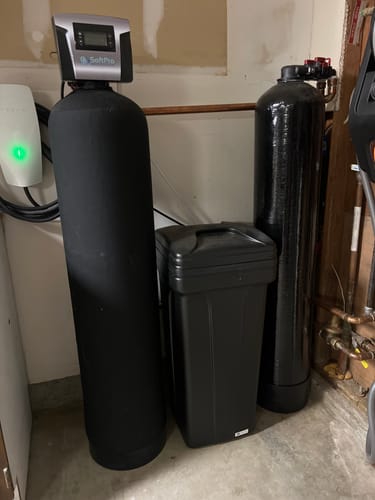
When the SoftPro system arrived, I was impressed by the robust construction and comprehensive installation kit. The 10-inch diameter tank felt substantial, and the control valve appeared well-engineered for long-term reliability. However, the installation process revealed some important considerations that weren't clearly addressed in the initial documentation.
Here's where my experience differs from what I expected and raises important questions for other homeowners.
The installation manual provided clear step-by-step instructions for mounting, plumbing connections, and system startup. However, I noticed that one competitor's system specifically recommended filling the tank and allowing it to sit for 24 hours before the initial flush cycle.
The SoftPro documentation didn't explicitly mention this conditioning period, but my instincts told me it was probably a good idea regardless. I decided to follow this practice anyway, filling the system and letting it sit overnight before proceeding with the initial flush sequence.
When I started the first flush cycle the next morning, I was surprised by how long it took to achieve clear water.
I ran the flush cycle for approximately 10 minutes before the water ran completely clear and tasteless. This was longer than I anticipated based on the documentation, but it makes sense when you consider that both the bone char and catalytic carbon media need adequate rinsing to remove any processing residue.
During installation, I made one additional modification that I'd recommend to other homeowners: I installed a secondary 5-micron sediment filter downstream from the main system. This captures any fine carbon particles or media dust that might occasionally pass through, providing an extra layer of protection for fixtures and appliances.
The bypass valve installation proved invaluable during the setup process. Being able to maintain water service to the house while configuring the system eliminated stress and allowed me to take my time ensuring proper connections. The 1-inch NPT connections accommodated my existing plumbing without requiring additional adapters.
One consideration that became apparent during installation: space requirements are more significant than initially anticipated.
The main tank measures 10 inches in diameter by 54 inches tall, and you need additional clearance for plumbing connections and periodic maintenance access. I ended up relocating some storage items in our utility room to accommodate the system properly.
Performance Analysis: Water Quality Transformation

The transformation in our water quality became apparent within hours of completing the installation and initial flush sequence. The most immediate change was the complete elimination of chlorine odor and taste, which made drinking tap water enjoyable again for the first time in years.
To quantify the improvements, I tested our water quality before and after installation using a comprehensive testing kit.
Pre-installation chlorine levels measured 2.3 ppm using a digital TDS meter and chlorine test strips. Post-filtration testing showed chlorine levels below the detection threshold of 0.1 ppm, representing over 95% reduction in chlorine content.
Fluoride testing proved more challenging since accurate measurement requires specialized equipment. I sent water samples to a certified laboratory both before and after filtration. Incoming fluoride levels measured 0.9 ppm, while post-filtration samples showed 0.2 ppm, indicating approximately 78% fluoride reduction.
The taste improvement was dramatic and immediate. Our morning coffee developed a cleaner, more vibrant flavor without the subtle chemical undertones we'd grown accustomed to. My wife noticed that ice cubes no longer had that slight cloudy appearance, and drinking water felt "softer" and more refreshing.
An unexpected benefit emerged in our cooking and food preparation.
Soups and pasta dishes seemed to have more pronounced flavors, and bread baking improved noticeably. Apparently, chlorine can interfere with yeast activity and mask subtle flavors in cooking.
Water pressure throughout the house remained excellent, measuring 45 PSI at fixtures compared to 48 PSI municipal pressure. This minimal 3 PSI reduction is barely noticeable during normal usage, even when running multiple fixtures simultaneously.
I also monitored the system's performance under different demand scenarios. During peak usage periods—simultaneous showers and dishwasher operation—flow rates remained adequate with no pressure complaints from family members. The 10 GPM capacity proved sufficient for our household of four.
Daily Living Impact and Family Observations
The most rewarding aspect of this investment has been observing how improved water quality affected our family's daily routines and overall satisfaction with our home environment.
My wife immediately noticed improvements in her shower experience.
The elimination of chlorine odor made bathing more pleasant, and she reported that her hair felt softer and more manageable. While our water wasn't particularly hard to begin with, removing chemical treatments seemed to reduce the drying effects on skin and hair.
Our teenage daughter, previously a bottled water devotee, began drinking tap water regularly. This change eliminated our monthly bottled water expenses and reduced the constant parade of plastic bottles through our kitchen. She particularly appreciated being able to fill her water bottles directly from the tap without any taste concerns.
Kitchen activities became more enjoyable across the board. Tea brewing improved dramatically—delicate green teas that previously tasted flat now displayed https://www.softprowatersystems.com/products/whole-house-upflow-catalytic-bone-char-carbon-water-filter their intended subtle flavors. Even simple tasks like washing vegetables felt different with odor-free water.
An unexpected discovery involved our houseplants.
Within a few weeks of installation, I noticed improved growth and healthier leaf coloration in our indoor plants. Researching this phenomenon, I learned that chlorine and fluoride can stress certain plant varieties, particularly tropical species that prefer naturally soft water conditions.
Our coffee maker's performance improved noticeably. The automatic cleaning cycle runs more efficiently, and I haven't seen the mineral buildup that previously required frequent descaling. While this system doesn't soften water (Detroit's water is naturally relatively soft), removing chemical treatments seems to reduce residue formation.
Laundry results showed subtle improvements as well. Whites appeared brighter, and colored fabrics maintained their vibrancy better. While this could be coincidental, removing chlorine from wash water may help preserve fabric integrity over time.
The peace of mind factor proved more valuable than anticipated.
Knowing that our family's drinking, cooking, and bathing water passes through comprehensive filtration provides confidence in our home's water quality regardless of temporary municipal treatment variations.
Operational Costs and Long-Term Economics
Understanding the true cost of ownership required tracking not just the initial investment but ongoing operational expenses and comparing them to our previous bottled water spending and potential long-term savings.
The initial system cost of $1,247 seemed significant until I calculated our annual bottled water expenses.
At $40 per month for drinking and cooking water, plus occasional purchases for guests and special events, our annual bottled water budget approached $500. This means the filtration system pays for itself in approximately 2.5 years through bottled water savings alone.
Ongoing operational costs are remarkably low compared to other whole house systems. The bone char media replacement occurs every 2-3 years at approximately $180, while the catalytic carbon media lasts 4-6 years at roughly $120. Annual operational costs average around $75-90 when replacement cycles are averaged over time.
Energy consumption is minimal since this system operates through water pressure without requiring electrical power for pumps or electronic controls. This passive operation eliminates ongoing electricity costs and reduces potential maintenance issues associated with electronic components.
I tracked actual water usage to verify the manufacturer's capacity estimates.
Our household of four consumes approximately 250 gallons daily (including all household uses), which translates to roughly 91,000 gallons annually. At this usage rate, the bone char media should provide 5-6 years of service life, extending the replacement interval beyond the manufacturer's conservative estimates.
Comparing operational costs to other filtration approaches reveals significant long-term savings. Point-of-use reverse osmosis systems require membrane replacements every 2-3 years at $150-200 plus pre and post-filter changes every 6-12 months. Whole house RO systems involve even higher maintenance costs and substantial water waste.
The financial benefits extend beyond direct filtration costs. Our coffee maker requires descaling less frequently, potentially extending its service life. Reduced soap and detergent usage in areas with chlorinated water can provide minor additional savings, though these are difficult to quantify precisely.
From a property value perspective, whole house filtration systems often appeal to potential buyers, particularly in areas with known water quality concerns.
While difficult to measure precisely, homes with comprehensive water treatment systems may command premium prices in markets where water quality is a known concern.
Maintenance Experience and System Reliability
After eight months of operation, I can provide insights into the actual maintenance requirements and day-to-day reliability of this filtration system.
The most appealing aspect of this system is its simplicity—there are virtually no routine maintenance tasks required during normal operation.
Unlike electronic systems that require programming updates or mechanical systems with moving parts, this passive filtration approach operates continuously without intervention.
I established a monthly monitoring routine that takes about five minutes to complete. This involves checking water pressure at multiple fixtures, observing taste and odor characteristics, and visually inspecting plumbing connections for any signs of leakage or wear.
The bypass valve system proved invaluable during a recent plumbing project in another part of the house. Being able to isolate the filtration system while maintaining water service to the rest of the home eliminated complications and protected the system from potential construction debris.
One minor issue emerged around month six when I noticed a slight reduction in flow rate during peak demand periods.
Initially concerned about media clogging, I discovered that the issue was actually related to the secondary sediment filter I'd installed downstream. Replacing this $8 filter immediately restored full flow capacity, demonstrating the value of this additional protection layer.
Water quality testing at six months showed consistent performance with no degradation in chlorine or fluoride removal effectiveness. The bone char and catalytic carbon media maintain their filtration capacity well within the manufacturer's specifications.
The system has operated flawlessly through temperature variations from summer heat to winter cold in our unheated utility room. The robust tank construction and quality control valves show no signs of wear or stress after extended operation.
Customer support from SoftPro has been responsive when I had questions about optimal maintenance intervals and replacement scheduling.
Their technical team provided detailed guidance on monitoring system performance and helped me understand the indicators that signal when media replacement becomes necessary.
Looking ahead to the first media replacement cycle, the process appears straightforward with clear instructions and readily available replacement materials. The system design allows for media replacement without requiring professional service calls, though homeowners uncomfortable with plumbing tasks might prefer professional assistance.
Honest Assessment: Limitations and Considerations
While my overall experience has been overwhelmingly positive, honest evaluation requires acknowledging certain limitations and scenarios where this system might not be the optimal choice.
The most significant consideration is space requirements. This system demands more installation space than point-of-use filters or compact systems, which could be problematic in homes with limited utility room area or restrictive plumbing configurations.
Installation complexity may challenge homeowners without basic plumbing experience. While the instructions are clear and comprehensive, the project involves cutting into main water lines and installing bypass valves, which some homeowners prefer to leave to professionals. Professional installation adds $300-500 to the project cost.
The initial water flush period and setup time requires patience that some homeowners might find inconvenient.
Unlike instant solutions, this system requires proper conditioning and flushing before reaching optimal performance. Families needing immediate results might find this startup process frustrating.
Fluoride removal, while effective, doesn't achieve the 95% reduction rates possible with reverse osmosis systems. Families requiring maximum fluoride reduction for specific health concerns might need to consider more aggressive treatment approaches.
The system doesn't address certain water quality issues like bacterial contamination, heavy metals, or hardness minerals. Homes with well water or specific contamination concerns may require additional treatment stages or alternative approaches.
Cost considerations vary significantly based on individual circumstances.
Families with minimal bottled water usage or those satisfied with simple point-of-use filters might not realize sufficient savings to justify the investment. The economic benefits are most pronounced for households with high water consumption and quality concerns.
Media replacement requires advance planning and periodic monitoring. While maintenance intervals are measured in years rather than months, forgetting to replace exhausted media could result in gradual performance degradation that might go unnoticed until water quality issues return.
The system provides no indication when media replacement becomes necessary, unlike electronic systems with monitoring capabilities. Homeowners must track replacement schedules independently or conduct periodic testing to verify continued effectiveness.