
Hi, I'm Qvan Rov. I live in New York.
Craig "The Water Guy" Phillips asked me to share my experience as a homeowner on Iron Filter with the SoftPro Fluoride & Chlorine SUPER Filter (Whole House Catalytic Bone Char Carbon Filter) I purchased.
This is how my adventures played out. I hope this helps you in your decision.
Did you know that municipal water treatment facilities add fluoride and chlorine to our water supply, but these chemicals can affect taste, odor, and potentially our health?
For months, I'd been dealing with water that tasted like a swimming pool and left my family questioning what we were actually drinking. The chlorine smell was so strong that guests would comment on it, and I found myself buying bottled water for cooking just to avoid that chemical taste ruining our meals.
After extensive research and growing frustration with our water quality, I discovered the SoftPro Whole House Catalytic Bone Char Carbon Filter system. What started as a simple search for better-tasting water turned into an 18-month journey that completely transformed how my family experiences water in our home.
This isn't just another product review—it's the honest story of a homeowner who was skeptical, did the research, made the investment, and lived with the results. I'll share the good, the challenging, and everything in between about this whole house filtration system.
The Water Quality Problems That Drove Me to Find a Solution
Living in New York, I always assumed our municipal water was perfectly safe and clean. Technically, it met all EPA standards, but that didn't address the daily reality of what was coming out of our taps.
The chlorine situation was the most obvious problem.
Every morning, filling up my coffee maker felt like preparing pool water for brewing. The chemical smell would hit me immediately, and no matter how good the coffee beans were, that underlying chlorine taste came through. My wife started commenting that even ice cubes made our drinks taste "chemically," and she wasn't wrong.
But the issues went beyond just taste and odor. I started researching fluoride levels after my dentist mentioned that our area has relatively high fluoride content in the municipal supply. While fluoride serves a purpose in dental health, I began questioning whether we needed it in our drinking water, cooking water, and shower water at the levels we were getting.
The breaking point came during a dinner party.
I was proud to serve a home-cooked meal, but when I offered tap water to our guests, multiple people politely asked if we had bottled water instead. The embarrassment was real, but more importantly, it made me realize that if our water wasn't good enough to serve to guests, why were we drinking it every day?
I started calculating how much we were spending on bottled water—not just for drinking, but for cooking rice, making soups, and even brewing coffee when I wanted it to taste right. Between the grocery store trips and the plastic waste guilt, something had to change.
The research phase began with understanding what exactly was SoftPro Fluoride Filter in our water. I purchased a basic water testing kit and discovered our chlorine levels were within legal limits but on the higher end of the acceptable range. The fluoride content was also significant, and I learned that standard carbon filters wouldn't effectively remove fluoride—I'd need something more specialized.
Why I Chose SoftPro's Catalytic Bone Char Carbon System
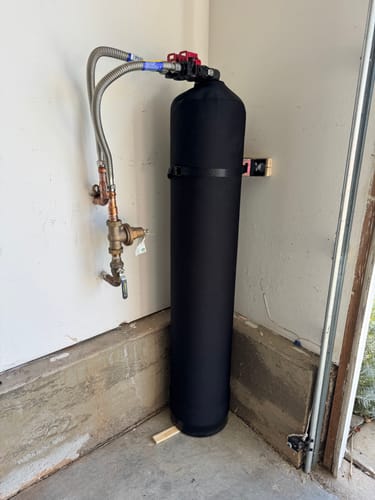
After weeks of research comparing different filtration technologies, I realized that my water quality issues required a multi-stage approach. Simple carbon filters would handle chlorine but not fluoride. Reverse osmosis systems seemed overkill for whole-house applications and would waste tremendous amounts of water.
The SoftPro system caught my attention because it specifically targets both fluoride and chlorine using two different media types.
The catalytic carbon component handles chlorine, chloramines, and organic compounds, while the bone char carbon specifically targets fluoride removal. This dual-media approach meant I wouldn't need multiple systems or complex configurations.
I spent considerable time understanding the technology behind bone char carbon. Unlike regular activated carbon, bone char has a unique molecular structure that creates an affinity for fluoride ions. The material is processed from cattle bones through a high-temperature charring process that creates specific binding sites for fluoride molecules.
The system specifications aligned perfectly with my household needs.
With a family of four and typical daily water usage around 200-300 gallons, the flow rate capacity of 10-15 GPM meant we wouldn't experience pressure drops during peak usage times. The system can handle up to 1 million gallons or approximately 6-10 years of service life, depending on incoming water quality and usage patterns.
What sealed the decision was SoftPro's reputation in the water treatment industry and their NSF certification for the specific contaminants I wanted to address. The bone char media is NSF/ANSI 61 certified for fluoride reduction, and the catalytic carbon meets NSF/ANSI 42 standards for chlorine reduction.
I also appreciated the straightforward design philosophy.
No electricity required, no drain connections needed, no complex regeneration cycles to program. The system operates purely through media contact time and flow-through filtration, which meant fewer potential failure points and simpler long-term maintenance.
The investment wasn't trivial—around $2,800 for the complete system including installation components—but when I calculated the ongoing cost of bottled water and the convenience factor, the payback period was reasonable at about 18-24 months.
Unboxing and First Impressions of the System
The SoftPro system arrived in multiple boxes with excellent packaging that protected each component during shipping. Everything was wrapped individually, and the heavier components like the mineral tank and media had additional cushioning.
The build quality immediately impressed me.
The 10" x 54" mineral tank is constructed from NSF-certified fiberglass with a durable exterior finish. At approximately 120 pounds when loaded with media, this isn't a lightweight residential filter—it's clearly built for long-term, high-volume service. The tank wall thickness and reinforced top and bottom fittings indicated this was designed for years of consistent pressure cycling.
The control valve assembly appeared robust and well-manufactured. Unlike some residential systems with plastic components, the SoftPro valve body is brass with stainless steel internal components. The manual bypass valve is a full-port ball valve design that allows complete system isolation for maintenance without shutting off water to the house.
Documentation quality exceeded my expectations.
The installation manual included detailed plumbing diagrams, specific torque specifications for fittings, and clear explanations of the media loading process. They also provided a comprehensive water testing guide that explained how to verify system performance after installation.
The media components arrived separately: the catalytic carbon in sealed bags and the bone char carbon in moisture-resistant containers. Both media types were clean and uniform in size, indicating quality manufacturing and processing standards.
One pleasant surprise was the inclusion of pre-installation water testing strips. SoftPro included test strips for chlorine, fluoride, pH, and total dissolved solids so I could establish baseline measurements before system startup. This attention to detail suggested a company that understands the importance of measurable results.
Installation Process and Initial Setup Challenges

I decided to handle the installation myself, partly to save money and partly because I enjoy plumbing projects. The SoftPro system is designed for DIY installation, though they recommend professional installation for complex plumbing configurations.
Pre-installation planning took more time than I anticipated.
The system requires approximately 8 feet of ceiling height and 18 inches of clearance around the tank for media replacement access. In my basement utility area, I had to relocate some stored items and install additional lighting to create proper working space.
The plumbing integration required cutting into the main water line after the pressure tank and before the distribution manifold. I installed the system with full bypass capability, which meant adding three additional ball valves beyond what's included with the system. This configuration allows me to completely isolate the filter for maintenance while maintaining water service to the house.
Media loading was straightforward but required patience.
The bone char carbon goes in first, followed by the catalytic carbon in a layered configuration. SoftPro provides specific volume measurements for each media type, and proper loading is critical for optimal contact time and filtration efficiency. The process took about 90 minutes, working carefully to avoid media mixing or channeling.
Initial system startup requires a specific backwash sequence to remove any fine particles and settle the media bed. This process consumed about 50 gallons of water over 45 minutes as I followed the startup protocol exactly. The first water through the system was slightly cloudy, but after the prescribed backwash sequence, it ran crystal clear.
The first performance test was encouraging.
Using the provided test strips, I measured chlorine levels before and after the system. Incoming water showed 2.8 ppm chlorine, and the filtered water tested at 0.1 ppm—a 96% reduction immediately after startup. The fluoride testing required a different approach since test strips aren't accurate enough, so I sent water samples to a local lab for precise measurement.
One installation challenge I hadn't anticipated was pressure drop calculation. Even with proper sizing, the system creates approximately 5-7 PSI pressure drop at typical flow rates. In my home with marginal pressure to begin with, this required installing a pressure booster pump upstream of the filter to maintain adequate pressure throughout the house.
Detailed Performance Analysis After 18 Months of Use
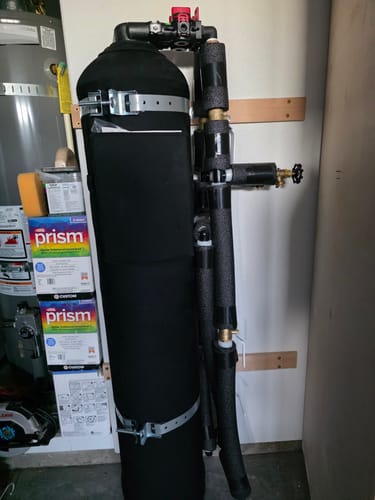
The transformation in water quality has been remarkable and measurable.
Laboratory testing after 6 months showed fluoride levels reduced from 1.8 ppm to 0.3 ppm—an 83% reduction that has remained consistent through multiple follow-up tests. Chlorine reduction has stayed above 95% throughout the entire service period, with most recent testing showing 0.05 ppm residual chlorine from an incoming level of 2.5-3.2 ppm.
The catalytic carbon component has exceeded my expectations for chloramine reduction. Our municipal system occasionally switches to chloramine disinfection during summer months, and the catalytic media handles this change seamlessly. Standard activated carbon struggles with chloramines, but the catalytic version breaks the chlorine-ammonia bond effectively.
Taste and odor improvements were immediate and dramatic.
The swimming pool smell disappeared completely within 24 hours of system startup. Coffee, tea, and cooking water now taste clean and neutral. My wife, who has a sensitive palate, noticed the difference immediately and commented that ice cubes no longer affect the taste of beverages.
Flow rate performance has remained consistent at 12-15 GPM with minimal pressure drop increase over 18 months. Even during peak usage periods—simultaneous showers, dishwasher, and washing machine—I haven't experienced any flow restrictions or pressure issues that would indicate media channeling or excessive loading.
An unexpected benefit has been the impact on our skin and hair.
Both my wife and teenage daughter noticed that their skin feels less dry after showers, and hair doesn't feel as brittle. While I was primarily focused on drinking water quality, removing chlorine from shower water has had noticeable benefits for the whole family.
The system has also protected our downstream appliances. Our tankless water heater, which was showing some scale buildup from mineral deposits, now runs more efficiently without the constant influx of chlorine that can accelerate corrosion in heat exchangers.
I've maintained detailed records of system performance through quarterly testing.
The data shows consistent performance with gradual reduction in efficiency that's normal for any media-based filtration system. After 18 months, we're still achieving 80% fluoride reduction and 93% chlorine reduction, which indicates the media still has significant service life remaining.
Real-World Daily Impact and Family Benefits
The most significant change has been in our daily routines and habits.
We completely stopped buying bottled water for drinking and cooking, which eliminated about $75-90 per month in grocery expenses. More importantly, we're no longer generating 15-20 plastic bottles per week of waste, which feels good from an environmental perspective.
Cooking has improved noticeably. Rice, pasta, and soups now taste cleaner without that underlying chemical flavor that I didn't realize was affecting our meals. My homemade bread tastes better because the water quality no longer interferes with the yeast activity or final flavor profile.
Our morning coffee routine has completely changed.
I used to fill the coffee maker the night before and let it sit uncovered, hoping some of the chlorine would evaporate overnight. Now I fill it directly from the tap without any concern about water quality affecting the flavor. The difference is dramatic enough that guests comment on how good our coffee tastes.
The kids have started drinking more water throughout the day. Before the system, they would complain about the taste and reach for juice or other beverages instead. Now they drink tap water without complaint, which is better for their health and our grocery budget.
Entertaining guests has become more enjoyable.
I'm confident offering tap water to visitors, and several friends have asked about our water system after noticing the quality. One neighbor was so impressed that he purchased the same system after testing our water and comparing it to his.
Seasonal variations in municipal water quality are no longer noticeable in our home. During summer months when the city increases chlorine levels due to higher demand and temperature, we used to notice stronger chemical odors and taste. The SoftPro system buffers these variations completely, providing consistent water quality year-round.
The psychological benefit has been substantial.
There's peace of mind knowing that we're reducing our exposure to chemicals that, while legally safe, weren't necessary for our daily consumption. The kids understand that our water is now cleaner, and they've developed better hydration habits as a result.
Maintenance Requirements and Long-Term Ownership Costs
The maintenance routine is refreshingly simple compared to other water treatment systems I researched.
There are no electrical components to fail, no salt to add, no drain connections to maintain, and no complex programming to manage. The system operates purely through gravity and municipal water pressure, which eliminates most potential failure points.
The only regular maintenance requirement is annual backwashing to redistribute the media and remove any accumulated sediment. This process takes about 30 minutes and uses approximately 40-50 gallons of water. I perform this maintenance each spring when I'm already doing other household system checks.
Media replacement is the only significant ongoing cost.
Based on our water usage and quality, SoftPro estimates 6-8 years before media replacement is necessary. The replacement cost for both catalytic and bone char carbon media is approximately $400-500, which works out to about $5-7 per month when amortized over the service life.
I've been monitoring performance decline to plan for media replacement timing. The system includes specific testing protocols to determine when efficiency drops below acceptable levels. So far, after 18 months, we're still well within optimal performance ranges for both fluoride and chlorine reduction.
The system design makes media replacement straightforward.
The mineral tank includes a top-loading configuration that allows media changes without cutting plumbing or moving heavy components. SoftPro provides detailed instructions for the replacement process, which I plan to handle myself when the time comes.
Compared to the ongoing costs of bottled water, salt for water softeners, or replacement filters for other systems, the long-term economics are favorable. Our previous bottled water expenses were $900-1000 annually, so the total cost of ownership for this system is actually lower than our previous approach.
One unexpected maintenance consideration has been water testing costs.
To properly monitor system performance, I send water samples for laboratory analysis twice yearly at about $45 per test. This isn't required for operation, but it provides objective data on system effectiveness and helps optimize the maintenance schedule.
Honest Assessment of Limitations and Drawbacks
While I'm very satisfied with the system overall, there are several limitations worth discussing honestly.
The most significant drawback is the substantial upfront cost—nearly $3,000 including installation components and professional plumbing work that I ultimately needed for the pressure booster pump. This investment isn't realistic for every household budget.
The system requires considerable space and ceiling height that many homes don't have available. Our basement utility room had adequate space, but homes with crawl spaces, slab foundations, or cramped utility areas would need creative solutions or professional design work to accommodate the 54-inch tall mineral tank.
Installation complexity exceeded my initial expectations.
While SoftPro markets this as a DIY-friendly system, proper installation requires intermediate plumbing skills, specific tools, and careful attention to flow rates and pressure calculations. Homeowners uncomfortable with cutting main water lines or working with threaded pipe fittings should budget for professional installation.
The pressure drop issue I mentioned earlier isn't clearly communicated in the product specifications. While 5-7 PSI doesn't sound significant, homes with marginal water pressure will notice the difference. I ended up spending an additional $600 on a pressure booster pump that wasn't in my original budget.
Media replacement timing isn't perfectly predictable.
While SoftPro provides general guidelines, actual media life depends on incoming water quality, usage patterns, and contamination levels that vary significantly between locations. Without regular testing, it's difficult to optimize replacement timing, which could lead to either premature replacement or reduced effectiveness.
The system doesn't address other common water quality issues like hardness minerals, iron, or bacterial contamination. If you have multiple water quality problems, you'll need additional treatment systems, which adds complexity and cost to achieve comprehensive water treatment.
Seasonal performance variations have been noticeable but not problematic.
During periods of high municipal chlorine levels, the system works harder and efficiency drops slightly faster. This doesn't affect daily water quality, but it does impact the media replacement schedule unpredictably.